Shi Ba Shi · eighteen forms, a continuous flow
Shi ba shi was developed by Lin Housheng in 1979. Its name refers to eighteen forms, bringing Tai Chi-inspired movement together with Qigong breathing and intention. The first set includes recognisable images such as painting a rainbow in the sky, embracing a mountain, rowing a boat and a dove spreading its wings.
Each form is repeated before moving on. The repetition trains coordination: arms, legs and the transfer of weight gradually become one action. Its accessible structure also gives beginners a way into the qualities of Tai Chi without first learning a long martial sequence.
Five Element · the body as part of nature
Wood, Fire, Earth, Metal and Water are five phases of change. In TCM they connect the seasons with organ systems and emotional qualities. Wood relates to Liver and Gallbladder; Fire to Heart and Small Intestine; Earth to Spleen and Stomach; Metal to Lung and Large Intestine; Water to Kidney and Bladder.
Five Element Qigong gives these relationships a physical form. Exercises may emphasise expanding, gathering, turning or releasing, with the intention of supporting the associated organ system and the circulation of Qi. Some teaching also combines movement with the Six Healing Sounds, voiced exhalations traditionally linked with particular organ systems.
The framework is useful because an emotion, season, organ and an exercise become parts of a connected lesson. Note it does not mean that an emotion proves an organ is unwell.
Heaven to Earth · restoring inner balance
This practice works with a central idea in Daoist cultivation: the human being stands between the energies of Heaven and Earth. Heaven suggests openness and the space above; Earth suggests nourishment, stability and the ground below.
This is a powerful Qigong system that includes filling the three elixir fields, or dantian: Movement, breath and intention are used to gather, cultivate and tonify Qi in these centres, with the main focus on the lower dantian for a grounded practice. This system is more similar to Zhan Zhuang as we do each exercise only once with longer holds.
Stress, overthinking and strong emotions are influences that can leave Qi excessive in the upper body and depleted below. Within this traditional understanding, Heaven to Earth works to redistribute Qi, nourish the lower body and bring Yin and Yang into a more balanced relationship.
Ba Duan Jin · eight pieces of brocade
Ba Duan Jin, also known as the Eight Pieces of Brocade or Eight Silk Brocades, is one of the world's most widely practiced forms of Qigong. Originating in the Song Dynasty (960–1279 CE), it consists of eight gentle, sequential movements that target specific organ systems.
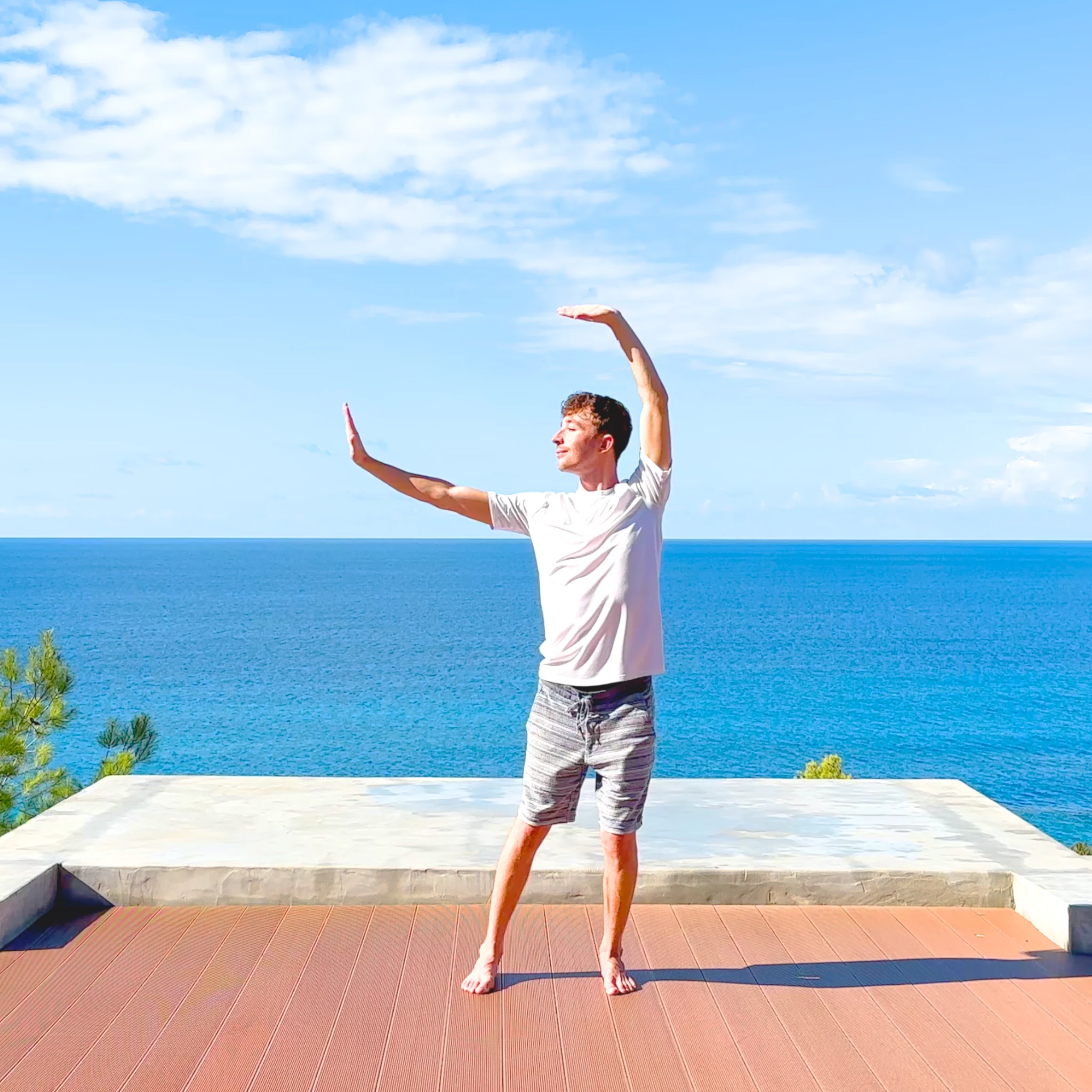
Two familiar examples show how the physical and energetic teachings meet. “Two Hands Support the Heavens” uses an overhead reach and is traditionally associated with the Triple Heater. “Open the Bow to Shoot the Golden Eagle” combines a grounded stance with an expansive action through the arms and chest. Other forms involve separating the hands, turning the head and controlled raising and lowering.
Zhan Zhuang · strength in stillness
Zhan Zhuang is a form of standing meditation in which postures are held rather than linked through flowing movement. Outwardly, very little happens, yet maintaining a balanced posture asks for strength, patience and endurance. The practice develops the ability to remain supported while releasing unnecessary muscular tension.
In Forest Rock’s teaching, the postures explore opposing forces and central equilibrium: a sense of expansion in different directions while remaining centred. Its traditional energetic purpose is to cultivate Qi and encourage circulation through the meridian network. The most widely practiced posture is 'Standing like a Tree' or 'Embrace Tree', the arms rounded in front as if holding a large ball or hugging a tree, with a soft bend in the knees.
Long Life · a wider experience
This system created by Forest Rock Qigong, brings a larger collection of exercises into a structured sequence concerned with vitality and health maintenance. Long Life Qigong draws from a range of lesser known traditional Qigong systems used in China for health and longevity. Its variety lets a class explore several movement qualities.
Breathing techniques and visualisation are woven into the movements, encouraging deep relaxation and helping to ease physical and mental tension. Each exercise has its own Traditional Chinese Medicine application, connecting the physical practice with the cultivation of Qi. Not just this system, but Qigong as a whole helps to support wellbeing as you grow older.
How these systems come together in class
I may teach exercises from several systems in one session, or spend more time with a particular sequence. We also use stretches, kou fa tapping, lymphatic flows, fascia release and energy flows alongside the main movements. I explain the purpose and offer variations so the session can work for different bodies.
You do not need to memorise every system at once. Learning a small group of forms well gives you something practical to take home, while the wider traditions leave plenty to explore.